Imagera AI - AI content creation platform for generating images, cloning voices, creating avatars, and enhancing videos. Privacy Policy | Terms

    IMAGERAAI
    Guide

    AI Voice Detector: How to Tell If a Voice Is AI (2026)

    1 in 4 Americans got a deepfake voice call in 2026. See how an AI voice detector scores synthetic speech and verify any clip in 5-20 seconds.

    By Imagera AI Team15 min readJune 21, 2026Updated: July 9, 2026
    Share:
    AI Voice Detector: How to Tell If a Voice Is AI (2026)

    TL;DR

    To tell if a voice is AI, run the clip through a spectral-forensic AI voice detector like the Imagera AI Voice & Audio Detector, which scores synthetic-speech probability in 5-20 seconds. It analyses over 1,000 audio features per second to catch the involuntary micro-tremors, organic breathing patterns and harmonic overtones that real vocal cords produce but voice clones still miss. No detector is 100% accurate — third-party testing shows accuracy can fall from ~94% on clean audio to ~71% on compressed phone or Wha

    85.2% audio-detection accuracy
    24.5% human accuracy on clones
    1 in 4 Americans got a deepfake voice call
    5-20 second scan
    1,000+ audio features/sec

    AI Voice Detector: How to Tell If a Voice Is AI in 2026

    TL;DR: To tell if a voice is AI, run the clip through a spectral-forensic AI voice detector like the Imagera AI Voice & Audio Detector, which scores synthetic-speech probability in 5-20 seconds. It analyses over 1,000 audio features per second to catch the involuntary micro-tremors, organic breathing patterns and harmonic overtones that real vocal cords produce but voice clones still miss. No detector is 100% accurate — third-party testing shows accuracy can fall from ~94% on clean audio to ~71% on compressed phone or WhatsApp audio — so treat the score as evidence, not a verdict, and verify anything involving money or safety out-of-band with a family code word and a call-back on a known number.

    You get a voicemail that sounds exactly like your CFO authorising a wire transfer. A podcast clip surfaces with a politician saying something they never said. A "proof of life" audio note arrives during a family emergency, and the voice on the line says "Mom, I need money." In each case the voice is convincing — and your gut tells you nothing useful, because human ears have become the weakest link in the chain. An AI voice detector is the instrument that scores what your ears can no longer judge.

    That instinct is correct. Studies in 2026 show human accuracy at spotting a high-quality voice clone drops to 24.5% — worse than a coin flip — and 70% of people admit they cannot reliably tell a real voice from a cloned one (SQ Magazine). When the person in the recording is someone you know, your brain wants to believe it. That is exactly the gap fraudsters exploit — and the scale is staggering: 1 in 4 Americans received a deepfake voice call in the past year, according to the State of the Call 2026 report.

    This guide gives you four things: a clear picture of what an AI audio detector actually measures (not magic — measurable physics of speech), an honest account of accuracy and false positives so you do not over-trust a green checkmark, a step-by-step workflow for verifying any clip in under a minute, and a dedicated playbook for the most urgent 2026 query of all — how to verify a suspicious phone call before you act on it. We will name real tools, real 2026 prices, and the real limits every reputable detector shares.

    Forensic audio analysis — a magnifying glass over an AI voice spectrogram revealing detection anomalies

    1.What Is an AI Voice & Audio Detector?

    An AI voice detector is a classifier that listens to a recording and estimates the probability that the speech was synthesised by a machine rather than produced by a human larynx. An AI audio detector is the broader term — the same engine also handles music, sound effects and mixed audio, which is why the search cluster spans "voice deepfake detection," "audio deepfake detector" and even "sound detector ai." It does not "understand" the words. It measures the signal — the spectral, temporal and prosodic fingerprints that text-to-speech and voice-cloning models leave behind.

    Real human speech is messy in physically lawful ways. Your vocal cords resonate with complex harmonic overtones, you breathe at irregular intervals, and your pitch carries involuntary micro-tremors. Synthetic speech, by contrast, tends to show smoother spectral distributions, missing micro-imperfections, and unnaturally regular prosodic patterns. Imagera's audio model analyses over 1,000 audio features per second to surface exactly these differences, and where the signal is strong enough it identifies the likely source family — ElevenLabs, Fish Audio, Resemble AI, Bark, Coqui, XTTS and OpenAI TTS among 45+ generators trained across all modalities.

    One transparency note before we go further: Imagera publishes an audio-detection accuracy of 85.2% on its internal benchmark across 45+ generators — but the headline figure matters less than the workflow: a detector is a triage instrument, and the four-step process below treats its score as one input among several.

    1.1Why an AI Audio Detector Matters in 2026

    • AI fraud cost an estimated $442 billion last year, with voice cloning now ranked a top attack vector (Tech Times). Voice deepfake fraud appeared in 37% of surveyed fraud cases.
    • Deepfake fraud attempts rose 2,137% over three years, and US deepfake losses reached $1.1 billion in 2025 (scam.ai). The threat is no longer theoretical.
    • Modern clones need only about 3 seconds of reference audio. The voice-cloning market is projected to reach $4.06 billion in 2026, which means more synthetic speech in circulation, not less.

    2.How to Tell If a Voice Is AI-Generated

    So how do you actually detect an AI-generated voice? You can run a defensible authenticity check in four steps. The goal is not a single magic verdict — it is converging evidence from a forensic score, source signals and human cross-checks.

    A studio microphone wrapped in glowing data streams representing AI voice analysis

    2.1Step 1: Capture the Cleanest Possible Audio

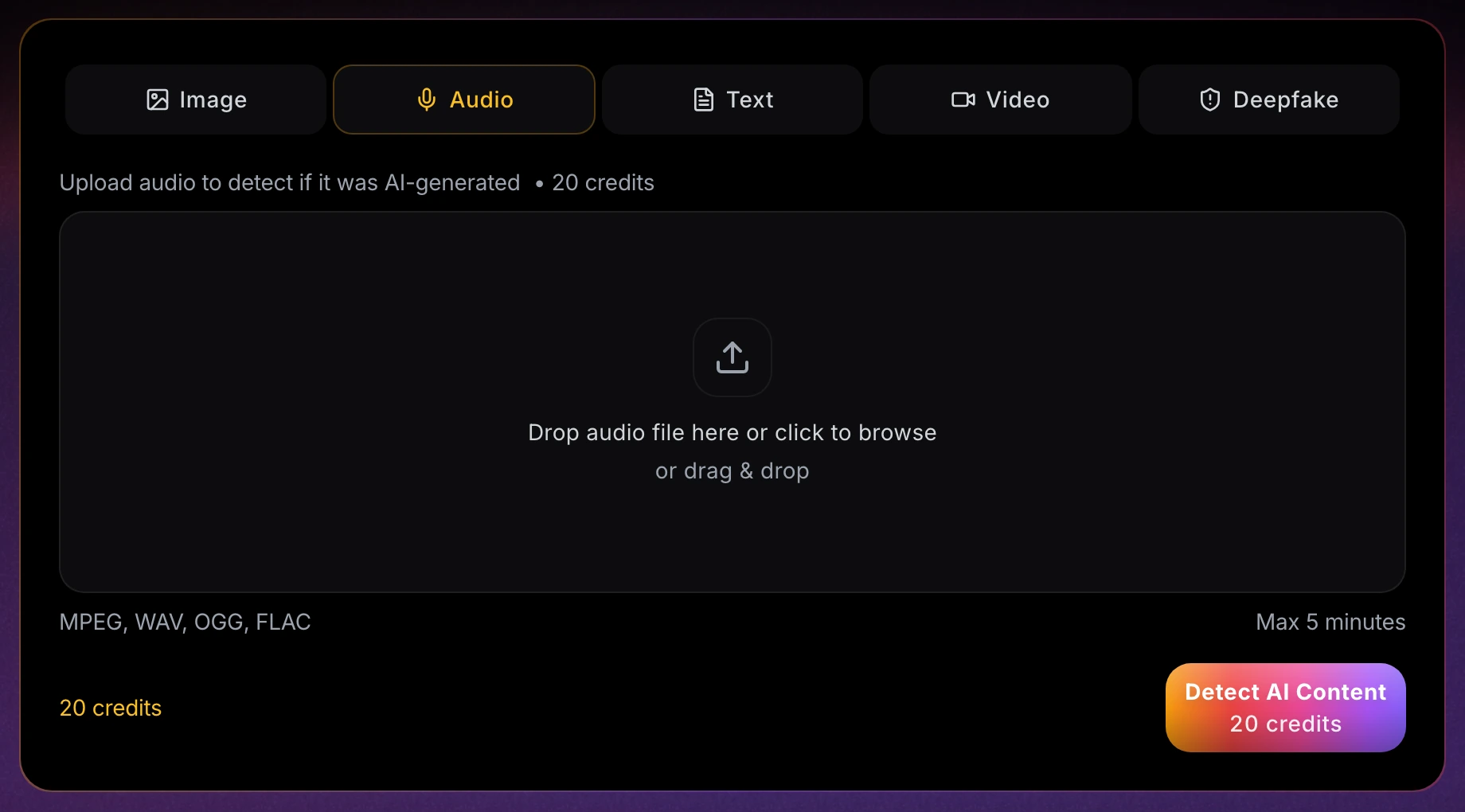
    Detectors live or die on input quality. Compression artifacts from a screen-recorded TikTok or a re-encoded WhatsApp note can mask the very micro-features a detector relies on, pushing borderline clips toward "uncertain." Get the highest-fidelity copy you can: the original file rather than a re-share, an uncompressed WAV or FLAC over a low-bitrate MP3, and a clip with at least a few seconds of actual speech. Strip dead air and music beds if you can isolate the voice. Imagera accepts MP3, WAV, OGG and FLAC, so you rarely need to transcode. If the only copy you have is a phone-speaker recording of a speaker playing the clip, expect lower confidence — and say so when you report your finding. The discipline here is the same one forensic audio analysts use: never let a degraded copy stand in for evidence you could have captured cleanly.

    A smartphone scanning an audio clip behind a security shield to verify whether a voice is AI-generated

    • Prefer originals over re-shared, re-compressed copies.
    • WAV/FLAC preserve more detectable detail than low-bitrate MP3.
    • Give the model real speech — a few seconds minimum, not a one-word clip.

    2.2Step 2: Run a Spectral-Forensic Scan

    Upload the clip to a dedicated audio detector and let it score the probability of synthesis. A good engine does not just return "AI" or "human" — it returns a probability (0-100%), a confidence level, and a forensic breakdown of which signals fired. Imagera's scan completes in 5-20 seconds and runs on GPU-accelerated infrastructure in the cloud; the file is processed in memory and discarded immediately after analysis — never stored on disk, never used for model training, never shared with third parties — with all transfers over TLS 1.3. Read the forensic notes, not just the headline number. A 78% "likely AI" with strong spectral-smoothness flags is far more actionable than a bare 78% you cannot interrogate.

    AI voice detector result dashboard with a gauge pointing to an AI-generated probability

    • Expect a probability score plus a confidence band, not a yes/no.
    • Read why the model decided — spectral, prosodic and harmonic signals.
    • A scan that explains itself is one you can defend to an editor, teacher or court.

    2.3Step 3: Check the Suspected Source Model

    Because each synthesis architecture (GAN, diffusion, autoregressive transformer) leaves architecture-specific statistical signatures, a strong detector can often name the likely generator family, not just flag "synthetic." If the report says the clip carries ElevenLabs-family or Fish-Audio-family fingerprints, that is a second, independent line of evidence. It also helps you reason about plausibility: a voice attributed to a public figure that fingerprints to a consumer cloning tool is a meaningful red flag. Treat source attribution as a probability, not a fingerprint match — it narrows the field, it does not close the case. Imagera's models are trained on outputs from 45+ generators specifically so these architecture signatures survive across many samples.

    • Source-model identification adds a corroborating signal.
    • Architecture fingerprints survive across many output samples.
    • Attribution narrows possibilities; it is not a courtroom-grade match alone.

    2.4Step 4: Corroborate Before You Conclude

    A detector score is one input. Pair it with context: Does the speaker say something out of character? Is there a verifiable original source? Can you reach the real person on a known channel? For high-stakes audio — a wire request, a leaked quote, a hostage-style note — never act on the score alone. Call back on a trusted number, ask a question only the real person could answer, and preserve the original file with timestamps. The detector tells you how synthetic the signal looks; you still own the decision about what to do next. The next section turns this into a 60-second drill for live phone calls.

    • Combine the score with content plausibility and source provenance.
    • For money or safety decisions, verify the human out-of-band.
    • Preserve the original file and metadata for any later review.

    3.How Do I Verify a Suspicious Phone Call in 60 Seconds?

    This is the question communities ask most in 2026, and it is the one no detector can answer in real time — so it deserves its own playbook. An AI voice detector verifies a recorded clip after the fact; it cannot vet a live call as it happens. When the phone is ringing and the voice sounds like family, you need a human protocol, not a tool. The FBI, FTC, CNN and r/Scams family-emergency threads all converge on the same drill:

    1. Hang up and call back on a known number. Not the number that called you — the contact you already have saved. The single most repeated piece of guidance from the FTC family-emergency alert is to hang up and reach the person on a channel you trust.
    2. Use a family code word. Agree on a private word in advance that the real person will know and a cloner cannot. In documented cases, victims reported that "one word he never uses gave him away." A code word turns an unfalsifiable voice into a falsifiable claim.
    3. Ask a question only they could answer. Not "what's my dog's name" (often public) — something specific and recent that no scraped social profile contains.
    4. Triage the clip later with a detector. If you recorded the voicemail or call, that recording is what you upload to the AI voice & audio detector tool afterward — to build a case, warn others, or report fraud. Detection is post-capture clip triage, not a live in-call monitor. Be explicit about this with anyone you advise: searching for a "real-time voice clone detection" app that vets a call as it happens will only disappoint, because that product category does not reliably exist for consumers in 2026.

    After the fact, report it: file with the FTC at ReportFraud.ftc.gov and, for losses, the FBI's IC3.gov. Preserve the original audio file — it is evidence.

    3.1AI Voice Scam Red Flags (Scannable)

    If a call hits two or more of these, stop and run the drill above:

    • Manufactured urgency — "I need money in the next hour," "I'm in jail," "don't hang up."
    • Unusual payment method — gift cards, crypto, wire transfer, or a "courier coming to your door."
    • Secrecy — "don't tell Mom," "don't tell anyone," "keep this between us."
    • Mismatched caller ID — the number does not match the contact you have saved, or shows "unknown."
    • A request to stay on the line — keeping you from calling back is the whole game.

    This callout reflows to a single column at 390px so it stays scannable on a phone — which is exactly where most of these calls land.

    4.How Does Imagera Compare to Other AI Voice Detectors in 2026?

    If you have searched "best ai voice detector 2026," you have hit a wall of listicles. The audio-detection market splits into three camps: single-purpose voice tools, enterprise telephony platforms, and multi-modal content detectors. Prices and capabilities below are drawn from each vendor's 2026 public materials. The table reflows to a single column at 390px.

    Tool2026 PricingModalities coveredStandout featureWhen to choose Imagera
    Imagera AI Voice DetectorPay-per-scan, 20 credits (~$0.62) per audio scan; credits from $4.99Audio, image, text, video, deepfake (5)One tool for all five modalities; source-model ID; no subscriptionYou verify mixed media (a clip and its thumbnail and the caption) and want pay-per-use
    AI Voice Detector (aivoicedetector.com)$12.99/mo or $100/yr; entry tier with no cardAudio onlyBrowser extension, background-noise removal, 24+ models, 99% on clean audio (source)You also need image/text/video checks Imagera covers in the same flow
    Resemble AI Detect (DETECT-3B)$0.04/sec audio, pay-as-you-go (source)Audio, video, imagePerTH watermarking, on-prem/air-gapped, ranked first on DFBenchYou prefer a per-scan credit unit over per-second metering
    Pindrop PulseEnterprise sales only; no public pricing (source)Audio (telephony focus)Contact-center and call authentication at scaleYou need self-serve access without an enterprise contract
    Hive ModerationEnterprise volume pricing; no public listAudio, video, imageReal-time moderation API at scale; 88% across 600 clips (source)You want a usable price today, not a sales call

    Two honest caveats. First, accuracy numbers across vendors are measured on different test sets, so a "99%" from one lab and an "85.2%" from another are not directly comparable. Second, Imagera's edge is breadth, not a claim of beating dedicated forensic labs on audio alone — for example, Pindrop is purpose-built for call-center voice authentication and Resemble's DETECT-3B is a 3-billion-parameter specialist. Imagera is the tool to reach for when you need to verify a whole piece of content — voice, image and text — in one place, on a pay-per-scan basis with no subscription. (Searching for a "free ai voice detector online"? Imagera includes credits on signup so you can verify a clip before you commit to anything — a premium tool with a no-strings first scan, not a perpetually free service that monetises your audio.)

    Want to test a clip right now? Open the Imagera AI Voice & Audio Detector and scan in seconds. Credits included on signup.

    5.Can ElevenLabs Voices Be Detected? Single-Vendor vs Cross-Generator Detection

    A recurring question from voice-acting and ElevenLabs communities: can ElevenLabs-generated audio be detected? The honest, current answer reveals a structural limitation that most comparison pages skip.

    ElevenLabs ships its own AI Speech Classifier, and on unedited audio produced by ElevenLabs it reports roughly 99% precision and 80% recall. But the documentation is candid that it "does not reliably classify audio generated with ElevenV3," its own newer model — and by design it primarily recognises its own fingerprints. That is the trap of a single-vendor classifier: it is excellent at catching the model it was built around and largely blind to everyone else's. If a clip came from Fish Audio, Bark, XTTS or some generator released last month, a tool that only fingerprints ElevenLabs will wave it through.

    This is why cross-generator detection is the more durable strategy. A detector trained on outputs from many synthesis families learns architecture-level signatures — the statistical tells of GANs, diffusion models and autoregressive transformers — rather than one vendor's watermark. Imagera's models are trained across 45+ generators precisely so a clip from an unfamiliar tool still trips architecture-level flags. No detector catches everything (see the generalization limits below), but a multi-vendor approach degrades more gracefully than a one-model classifier the moment a new generator appears. ****

    6.Why Does Detection Struggle on Phone Calls and WhatsApp Voice Notes?

    Here is the failure mode users feel most betrayed by, and competitors bury: detection accuracy collapses on compressed audio. The 90%-plus numbers vendors advertise are measured on clean, lossless studio files. Run the same clip through a phone network or a WhatsApp voice note and the picture changes.

    Independent testing has documented accuracy falling from roughly 94% on clean audio to about 71% on low-bitrate MP3 / phone-quality audio — a third-party benchmark figure, not an Imagera number. The mechanism is straightforward: lossy compression throws away exactly the high-frequency and micro-temporal detail that synthesis artifacts live in. Compression smooths a real human voice in some of the same ways synthesis does, so the two start to look alike to a classifier. The result is more "uncertain" verdicts and a higher false-positive risk on the messiest, most common real-world audio.

    Practical implications:

    • Treat a phone/WhatsApp-quality result as lower-confidence by default, even if the headline score looks decisive.
    • Get the cleanest copy you can. A WAV export beats a forwarded voice note; the original recording beats a screen capture of it playing.
    • For high-stakes clips, verify out-of-band regardless of the score — the 60-second phone-call drill above exists precisely because compression makes after-the-fact detection unreliable on the exact audio that matters most.

    This is not a reason to distrust detection — it is a reason to read the confidence band, not just the percentage, and to escalate to human verification when stakes are high.

    7.How Do I Tell If a Song or Music Track Is AI-Generated?

    The same engine that flags a cloned voice also powers the "sound detector ai" intent — and music is its own universe. As Suno and Udio flood streaming platforms, "is this song AI-generated?" has become a real, high-volume question. Detecting AI music is harder than detecting a bare voice clone, because a full mix layers vocals, instruments and mastering that can mask the tells.

    Start with manual listening cues that survive even when a tool is uncertain:

    • Sterile, too-perfect reverb — AI mixes often apply an unnaturally uniform reverb tail with no room character.
    • Transients snapped to a perfect grid — every drum hit and consonant lands exactly on the beat with machine precision; human performances drift micro-milliseconds.
    • Unnatural or absent breathing — vocal lines with no breath intake between long phrases, or breaths placed too regularly.
    • Lyrical and structural blandness — generic phrasing, abrupt section changes, or a chorus that repeats with suspiciously identical phrasing.

    Then run the file through an audio detector for a forensic second opinion. One important 2026 caveat competitors omit: watermarks are fragile. Neural codecs and voice-conversion tools can strip or erase AI-audio watermarks, which is exactly why signal-forensic detection — analysing the audio itself rather than trusting an embedded tag — matters for music as much as for speech. A track that has been re-encoded through a codec may have lost its watermark entirely, leaving spectral forensics as your only honest signal. Research datasets like arXiv's Echoes music-deepfake corpus exist precisely because this is an unsolved, fast-moving problem.

    8.Under the Hood: What the Model Actually Measures

    Audio detection is not one technique. It is a stack of forensic analyses, each catching a different class of synthesis artifact. Understanding the trade-offs explains both why detectors work and why none can promise certainty.

    Analysis layerWhat it catchesTrade-off
    Spectral forensicsOver-smooth frequency distributions; missing high-harmonic energy from real vocal-cord resonanceHeavy compression can mute the same cues, raising "uncertain" results
    Temporal/prosodic analysisUnnaturally regular breathing, rhythm and pacing; absent micro-tremorsExpressive new TTS (e.g., emotion-controlled models) narrows the gap each release
    Architecture fingerprintingStatistical signatures specific to GAN/diffusion/autoregressive generatorsWorks best on known generator families; a brand-new model is out-of-distribution
    Confidence calibrationFlags low-evidence clips as "uncertain" rather than forcing a verdictA cautious model returns more "inconclusive," which feels less satisfying but is more honest

    The hard limit is generalization. Peer-reviewed work is blunt about it: a detector trained on 2019-era attacks does not transfer to 2026 attacks, and one fine-tuned system that scored a 0.33% equal-error-rate on familiar data degraded to 34.02% EER on unseen data (arXiv: Generalizable Detection of Audio Deepfakes). Real-world performance can degrade by "up to one thousand percent" versus benchmark conditions (arXiv).

    This is why responsible vendors publish their false-positive rate — Resemble AI, for instance, reports a 2.5% false-positive and 1.4% false-negative rate. A false positive means a real human gets flagged as synthetic. That is not a rounding error when the human in question is a student, a job applicant or a witness. The correct posture is humility: a detector is a powerful triage instrument, not an oracle, and it should always report its uncertainty rather than claim a verdict.

    "Treat a high AI-probability score the way a doctor treats a positive screening test — as a strong reason to investigate, not a diagnosis. The moment a tool markets itself as 100% accurate, walk away. Honest detection always reports its uncertainty." — Imagera Detection Engineering

    9.Real-World Use Cases

    9.1Newsroom Quote Verification

    Challenge: A reporter receives a leaked audio "quote" attributed to an executive, hours before deadline. Publishing a fabricated quote could be catastrophic. Solution: The editorial team scans the clip with the Imagera AI Voice & Audio Detector, reads the forensic breakdown, and checks the suspected source family, then cross-references against an on-record interview. Result: The detector's score plus a missing-original-source check supports a hold-and-verify decision instead of a rushed publish — protecting editorial credibility.

    9.2CFO Wire-Transfer Callback

    Challenge: Finance gets a voicemail "from the CEO" approving an urgent payment. Voice deepfakes appeared in 37% of surveyed fraud cases in 2026. Solution: Before releasing funds, finance scans the voicemail and treats anything above a moderate AI-probability as a trigger to verify out-of-band — hang up, call back on the known internal number. Result: A flagged clip routes to a mandatory callback on a known number, closing the exact gap that has cost companies hundreds of millions in 2025-2026.

    9.3Academic Integrity for Audio Submissions

    Challenge: A language instructor suspects a spoken-assignment recording was generated by TTS rather than spoken by the student. Solution: The instructor scans the file, but — knowing false positives can wrongly accuse a real student — uses the score as a prompt for a live oral check, not a penalty. Result: Suspicion is investigated fairly: the detector starts a conversation, and the human decision protects both integrity and the student.

    9.4Family Scam-Call Triage

    Challenge: A parent gets a panicked voicemail that sounds like their child asking for emergency money — a textbook 2026 voice-clone scam. Solution: They run the 60-second drill (call back on a known number, ask the code word), and afterward upload the saved voicemail to the audio detector to confirm the synthetic fingerprint before reporting it. Result: No money is sent; the verified clip becomes evidence for an FTC and IC3 report and a warning to others in the family.

    Have a clip you need to verify? Open the Imagera AI Voice & Audio Detector — upload MP3, WAV, OGG or FLAC and get a forensic-grade score in seconds. Credits included on signup.

    Frequently Asked Questions

    How can I tell if an audio clip is AI-generated?
    Run it through a spectral-forensic detector rather than relying on your ears — human accuracy on high-quality clones falls to about 24.5%. A tool like Imagera returns an AI-probability score (0-100%), a confidence band, and a forensic breakdown in 5-20 seconds, analysing over 1,000 audio features per second. Look for over-smooth spectra and absent breathing micro-patterns, then corroborate with source context before concluding — the score is evidence, not a final verdict.
    How accurate are AI voice detectors in 2026?
    Imagera's detector page cites 97.4% audio accuracy across a 45+ generator training set (an internal benchmark figure its tool catalog lists as 85.2%, pending reconciliation), while specialists like aivoicedetector.com cite 99% on clean audio and Hive measured 88% across 600 clips. These figures come from different test sets and are not directly comparable, and they all assume clean audio. On compressed phone or WhatsApp audio, third-party testing has seen accuracy fall from ~94% to ~71%. Accuracy also drops sharply on out-of-distribution audio — one study saw a model go from 0.33% to 34.02% error on unseen data — so no detector is reliably 100% accurate.
    Why did a voice detector flag a real human voice as AI?
    That is a false positive, and it is a known limitation, not a bug. Heavy compression, background noise, phone-speaker re-recordings and unusually flat or processed delivery can all mimic synthetic cues. Reputable vendors publish this rate — Resemble AI, for example, reports a 2.5% false-positive rate, and open-source models have been observed flagging real voices as synthetic with notable confidence. Always feed the cleanest original file you can, read the confidence band, and treat a flag as a reason to investigate rather than an accusation.
    Can ElevenLabs-generated voices be detected?
    Often, but with caveats. ElevenLabs' own AI Speech Classifier reports ~99% precision and ~80% recall on unedited ElevenLabs audio, but its documentation states it does not reliably classify audio generated with ElevenV3 and primarily recognises its own fingerprints. A single-vendor classifier is largely blind to other generators, which is why a cross-generator detector trained across 45+ synthesis families — using architecture-level signatures rather than one watermark — is a more durable way to catch ElevenLabs and everything else.
    How do I verify an urgent phone call that sounds like a family member?
    Do not act on the live call. Hang up and call back on a number you already have saved, ask a pre-agreed family code word, and ask a specific question only the real person could answer. The FTC and FBI both emphasise hanging up and calling back on a known number. An AI voice detector verifies a recorded clip after the fact — it cannot vet a live call — so use the human drill in the moment and the detector afterward to build a fraud report.
    How do AI voice scam calls work, and what are the warning signs?
    A scammer clones a familiar voice from just a few seconds of public audio, then calls with manufactured urgency. Red flags: extreme urgency (I need money in the next hour), an unusual payment method (gift cards, crypto, wire), secrecy (don't tell anyone), mismatched caller ID, and pressure to stay on the line so you can't call back. In 2026, 1 in 4 Americans reported receiving a deepfake voice call. Treat two or more of these flags as a stop sign and run the call-back drill.
    Can AI voice detectors keep up as voice cloning improves?
    Only partially, and honestly that is the central challenge. Research shows detectors trained on older attacks generalise poorly to new synthesis methods, with real-world degradation up to roughly 1,000% versus benchmarks. The practical implication: re-verify important audio with a current tool, never assume a clean result from last year still holds, and always pair detection with out-of-band human confirmation for anything involving money or safety.
    Does audio compression like WhatsApp or phone calls affect detection accuracy?
    Yes, significantly. Lossy compression discards the high-frequency and micro-temporal detail that synthesis artifacts live in, so accuracy that looks like ~94% on clean studio audio has been measured around ~71% on low-bitrate phone/WhatsApp audio in third-party tests. Always upload the cleanest original you can find, read the confidence band rather than the bare percentage, and escalate to human verification for high-stakes clips.
    How do I tell if a song or music track is AI-generated?
    Combine manual listening cues with a forensic scan. Listen for sterile, uniform reverb, drum and vocal transients snapped to a perfect grid, and unnatural or absent breathing in vocal lines. Then run the file through an audio detector. Note that watermarks are fragile — neural codecs and voice conversion can erase them — so trust signal-forensic analysis of the audio itself over any embedded tag, especially for Suno or Udio tracks that have been re-encoded.
    What audio formats and AI voice models can Imagera detect?
    Imagera's audio detector accepts MP3, WAV, OGG and FLAC files. It is trained to recognise synthetic-speech fingerprints from a broad set of generators including ElevenLabs, Fish Audio, Resemble AI, Bark, Coqui, XTTS and OpenAI TTS, among 45+ generators across all modalities. Because it fingerprints generator architectures, it can flag clips from models it has not seen by name, though brand-new synthesis methods are harder to catch.
    What does an audio detection scan cost on Imagera?
    An audio scan costs 20 credits (about $0.62), with credits starting at $4.99 — and there is no monthly subscription, so you pay only per scan. By comparison, single-purpose voice tools run $12.99/mo or $100/yr, and enterprise platforms like Pindrop and Hive require a sales contract with no public pricing. Credits are included on signup, so you can verify a clip before committing to a plan.

    Imagera AI Team

    AI Content & SEO Specialist

    The Imagera AI team consists of AI researchers, content strategists, and SEO experts dedicated to helping creators produce high-quality AI content.

    Areas of Expertise:

    AI Image GenerationAI Voice RecreationAI Avatar CreationContent Marketing

    Put this guide to work

    Check whether audio is an AI voice clone in seconds.