AI image generation went from a research demo to an everyday creative tool in a few years, and the numbers quoted about it have multiplied just as fast — many of them without a source you can open. This page keeps only figures we could trace to the organisation that published them, with the date each was published.
How this page works: every statistic below was opened at its source on 29 September 2026, and we quote it as published. Where the newest public figure is older than 2026, we say so instead of projecting it forward. Market-size forecasts behind research-firm paywalls are left out, because we could not read them.
Last reviewed: 29 September 2026
1.How many AI images have been created?
The most-cited independent count is Everypixel Journal's, published in August 2023. No newer independent tally has been published that we could verify; the platform totals quoted since then are self-reported by the companies that run them.
1. More than 15 billion images had been created with text-to-image tools by mid-2023. (Everypixel Journal, Aug 2023)
2. That was an average of 34 million images a day since DALL-E 2 launched. (Everypixel Journal, Aug 2023)
3. Adobe Firefly reached 1 billion images within three months of launch. (Everypixel Journal, Aug 2023)
4. Midjourney had 15 million registered users at the time of the same count. (Everypixel Journal, Aug 2023)
2.Adoption and investment
5. Organisational adoption of AI reached 88%. (Stanford HAI, 2026 AI Index Report)
6. 4 in 5 university students now use generative AI. (Stanford HAI, 2026 AI Index Report)
7. U.S. private AI investment reached $285.9 billion in 2025, more than 23 times the $12.4 billion invested in China. (Stanford HAI, 2026 AI Index Report)
3.Trust, public opinion and AI-generated content
8. 73% of AI experts expect AI to have a positive impact on work, compared with 23% of the public. (Stanford HAI, 2026 AI Index Report)
9. 56% of AI experts expect AI to have a very or somewhat positive impact on the United States over the next 20 years, against 17% of U.S. adults. (Pew Research Center, Apr 2025)
10. 66% of U.S. adults and 70% of AI experts are highly concerned about people getting inaccurate information from AI. (Pew Research Center, Apr 2025)
11. 55% of U.S. adults (and 57% of experts) want more control over how AI is used in their lives. (Pew Research Center, Apr 2025)
12. 58% of people say they are concerned about their ability to tell what is true from what is false in news online. (Reuters Institute, Digital News Report 2025)
13. 7% of people use AI chatbots for news each week, rising to 15% of under-25s. (Reuters Institute, Digital News Report 2025)
4.Watermarking, detection and labeling rules
14. More than 10 billion pieces of content had been watermarked with Google's SynthID by May 2025. (Google, May 2025)
15. From 2 August 2026, the EU AI Act requires AI systems that generate synthetic images, audio or video to mark their outputs "in a machine-readable format and detectable as artificially generated or manipulated", and deployers of deepfakes to disclose them. (EU AI Act, Article 50)
If you need to check an image yourself, Imagera's AI Image Detection tool gives a confidence score for a single upload. Treat any detector's result as evidence, not proof.
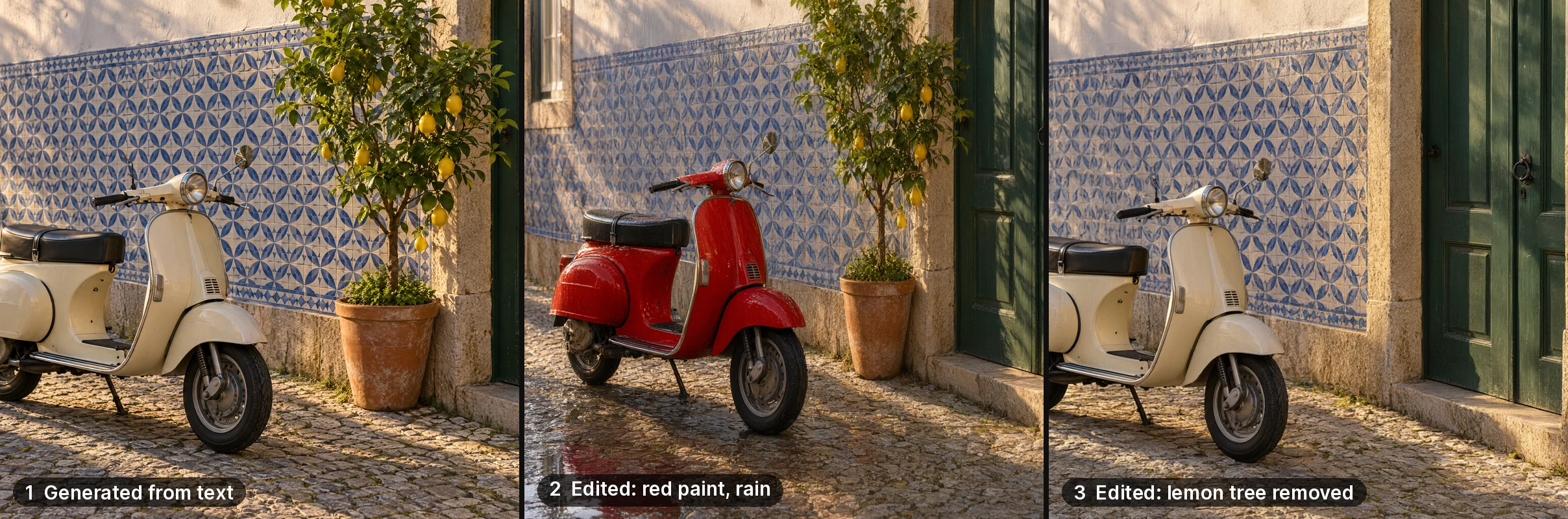
Three common ways people use these tools, on one subject, made for this article: (1) text-to-image with ChatGPT 2.5 Flare; (2) an image-to-image edit and (3) an object removal, both instruction edits with Imagera Typeset 3 (Edit). Unedited output.
5.See it in action — real Imagera output
This is real, unedited output from ChatGPT 2.5 Flare, one of the image models in Imagera Sandbox, made for this article.
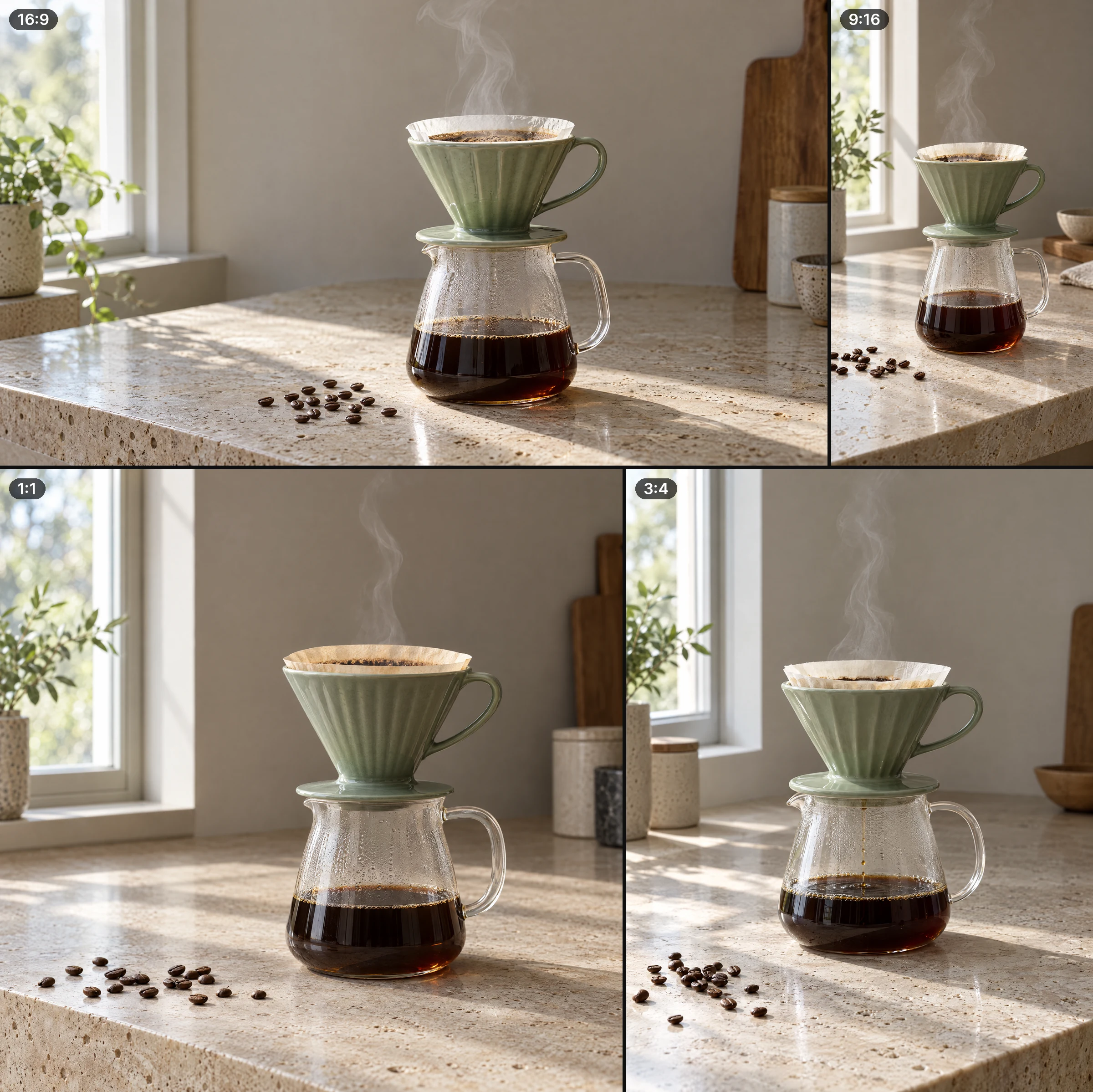
Real output: one prompt run four times with ChatGPT 2.5 Flare at 2K, one per aspect ratio (16:9, 9:16, 1:1, 3:4), unedited.
Try ChatGPT 2.5 Flare in Sandbox →
6.Where AI image generation shows up in practice
The table below is our editorial read of where image generation earns a place in real workflows, not survey data. Actual mixes vary by team and industry.
| Use case | Typical adoption tier | Primary driver | Where it shows up |
|---|---|---|---|
| Product & e-commerce imagery | High | Volume of SKUs, cost per shoot | Catalog pages, marketplaces, ads |
| Social & marketing creative | High | Weekly posting cadence | Feeds, thumbnails, campaign variants |
| Photo restoration & upscaling | Medium-high | Legacy assets, print needs | Real estate, archives, catalogs |
| Concept & moodboards | Medium | Speed of iteration | Design and pre-production teams |
| Fully synthetic "hero" art | Lower | Brand-consistency limits | Editorial, experimental campaigns |
The tools that stick solve a specific production bottleneck — replacing a photoshoot, resizing a back catalog, generating ad variants — rather than promising general creativity. You can try that on Imagera across image generation, image editing and upscaling.
7.Sources and corrections
Each figure above links to the page it came from. We re-check this page when a source publishes a newer edition; the date at the top shows the last review. If a source has been updated or you spot an error, tell us through support.
Cite this page: Imagera, "AI Image Generation Statistics 2026: Sourced and Dated," Imagera AI, September 2026. https://imagera.ai/blog/ai-image-generation-statistics-2026