If you want a terminal agent like Claude Code but with the model chosen per session, Imagera Code is the closest swap. If you want an agent inside a subscription that also offers third-party models, look at Cursor. If running a local model matters most, look at Aider.
Claude Code is still the better choice in some cases, covered below. Details about Claude Code, Cursor and Aider on this page were read from their own pages in November 2026.
What are the best alternatives to Claude Code, and which one should I use?
Three options cover most reasons for leaving.
- Imagera Code: a coding agent that runs in the terminal. You pick the model per session, and usage is billed in credits. Pick it when model choice is the reason you are leaving.
- Cursor Agent: completes complex coding tasks independently, runs terminal commands, and edits code. Pick it when you want one subscription that covers the agent and third-party models.
- Aider: works with local models, for example using Ollama. Pick it when the model must run on your machine.
Stay with Claude Code if you already pay for a Claude plan and want its multi-agent mode. Claude Code can spawn multiple agents that work on different parts of a task simultaneously, with a lead agent coordinating subtasks and merging results. If that is the feature you want, none of the alternatives above is a reason to move.
Which alternatives can work across my codebase, edit files, and run commands?
Autocomplete tools suggest the next lines. An agent reads files, changes several of them, runs your tests, and reacts to the output. That is the bar.
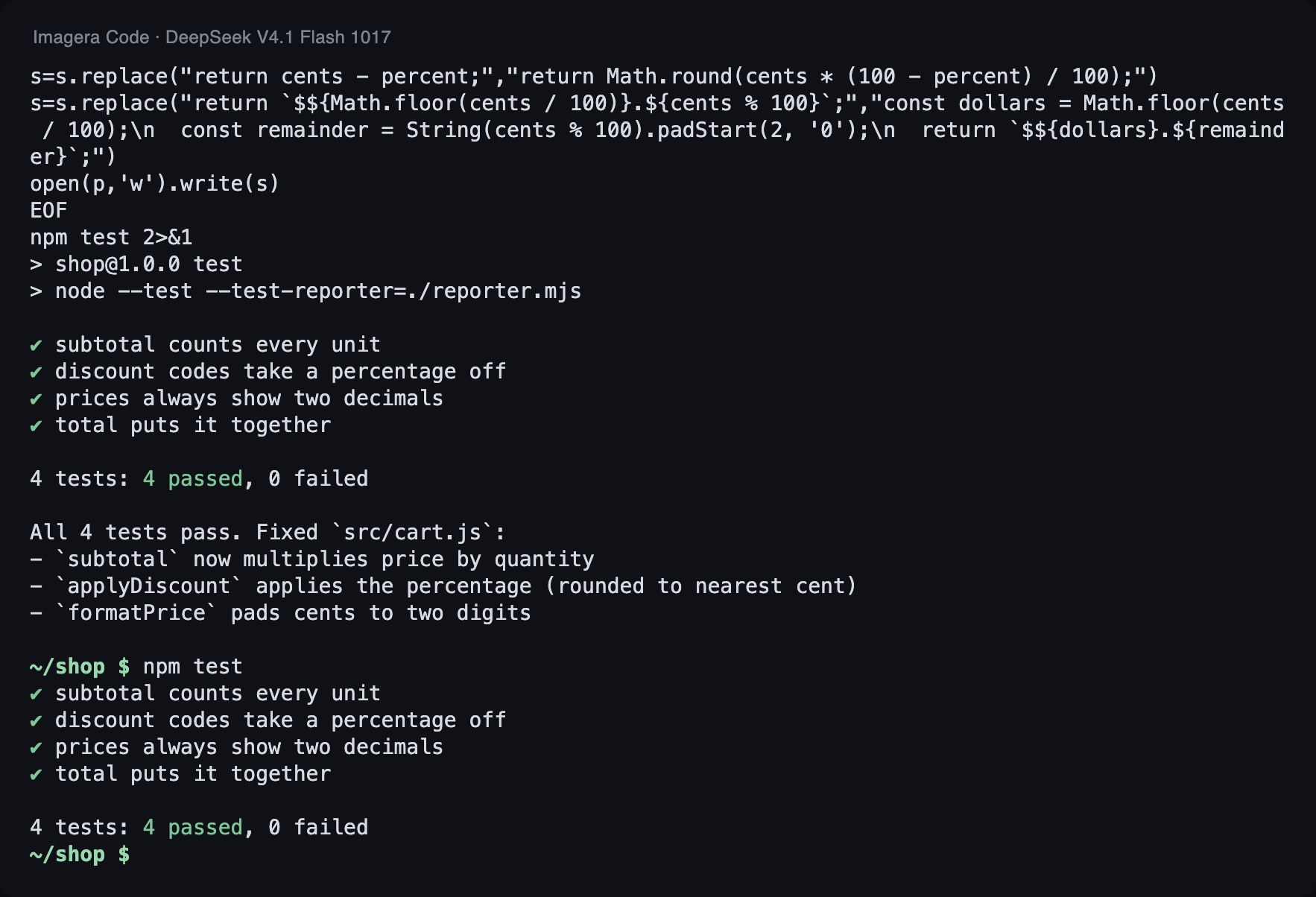
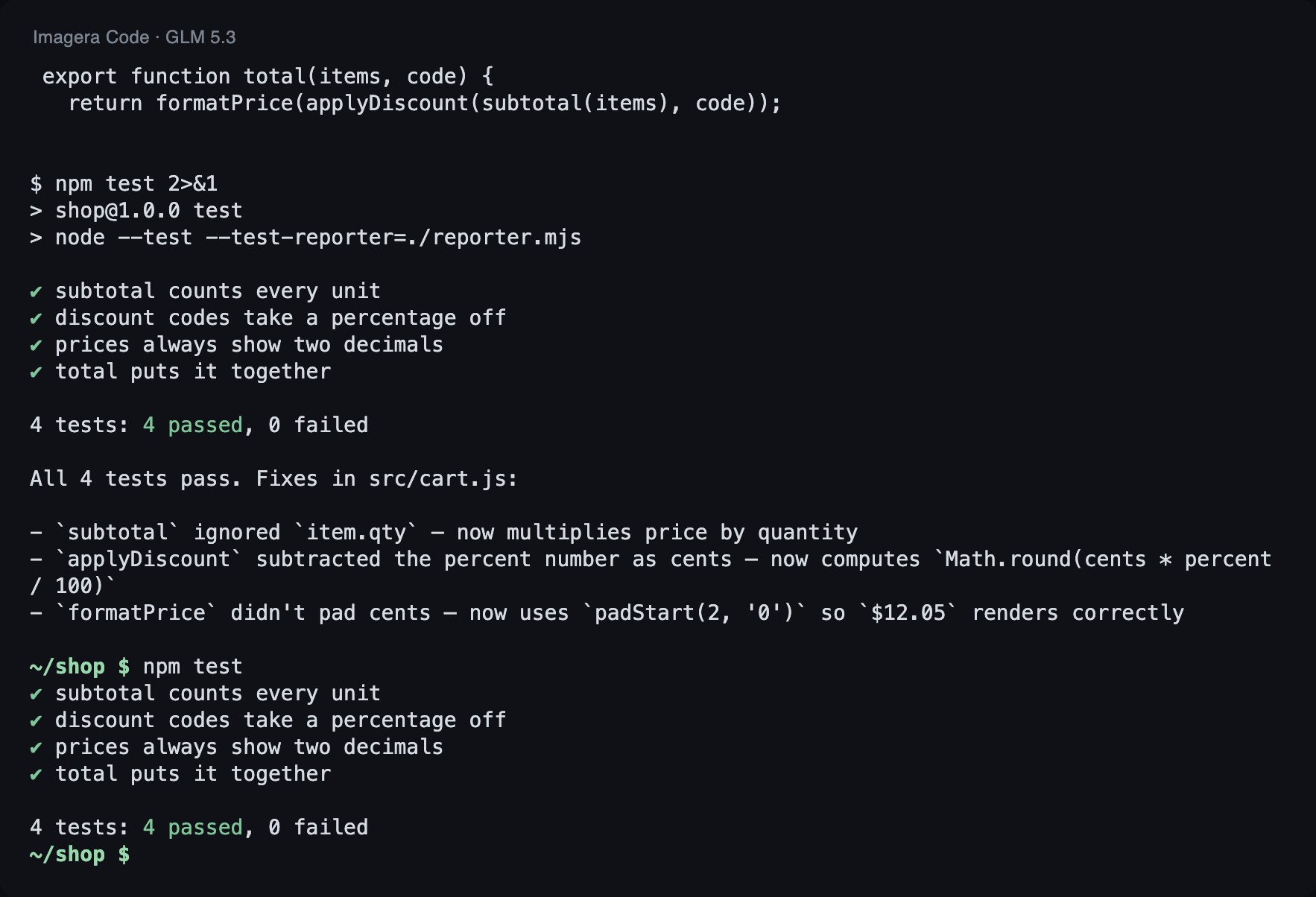
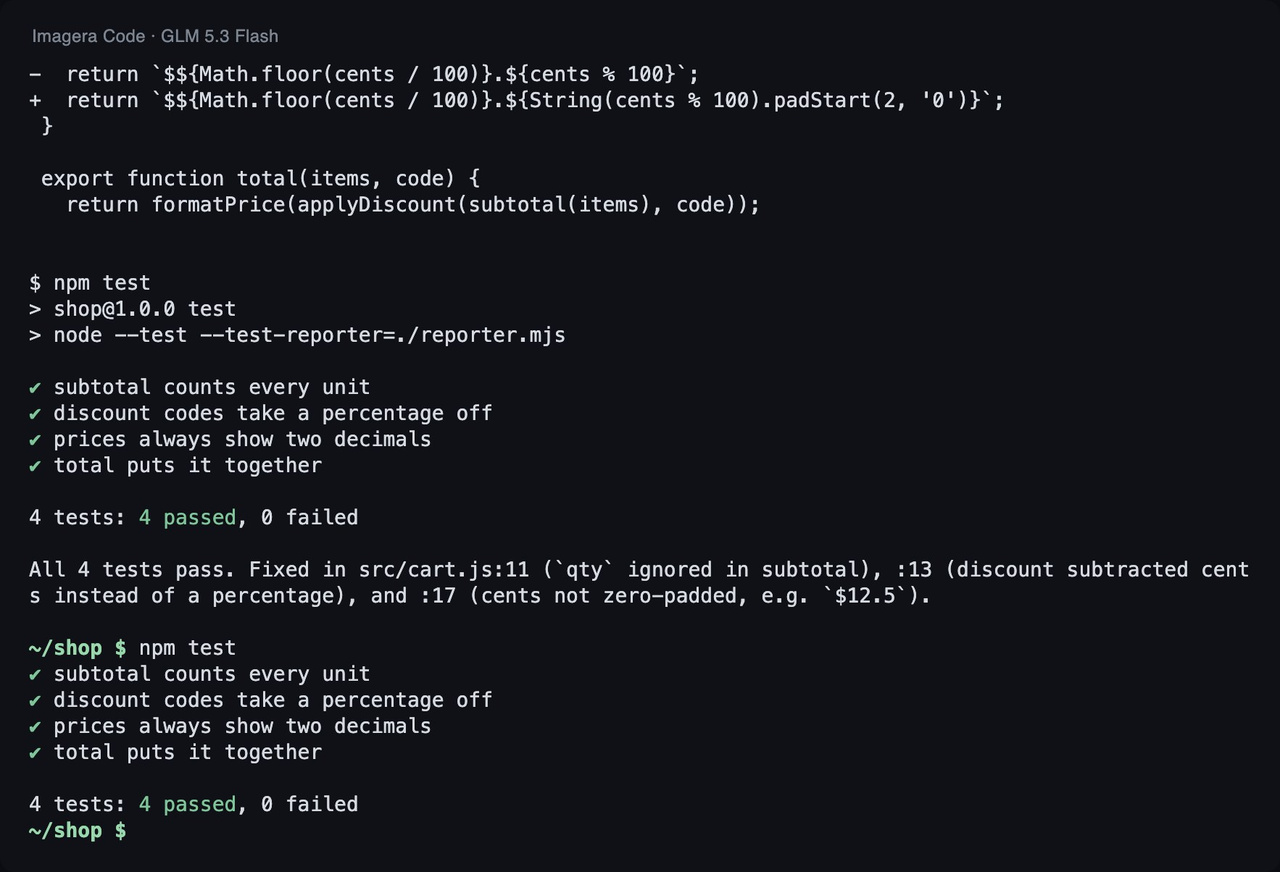
Cursor Agent meets it: it can run terminal commands and edit code while completing tasks on its own. Imagera Code meets the bar in the terminal, and the test below shows it fixing a real project end to end.
For Aider, the page we read documents local-model support. It does not describe the agent features in enough detail for us to say how it handles commands, so check its docs against your own needs before you commit to it.
How do they compare with Claude Code on coding quality, reliability, and price?
We have not run Claude Code, Cursor and Aider against each other on the same task, so we will not rank them on quality or reliability. Our test below covers only Imagera Code across models.
Model access is one concrete difference. Claude Code supports Claude Sonnet 5.5, selectable with /model or by starting a session with claude --model claude-sonnet-5-5. In our test, Imagera Code also ran Claude Sonnet 5.5, next to seven other models, in the same tool.
On price, the structures differ:
- Claude Code is included in all paid Claude plans and shares the same usage limits as the rest of your plan. Claude's individual Pro plan is $20 per month when billed monthly. The free claude.ai plan does not include Claude Code.
- Cursor's Premium plan costs $30 per month and makes third-party models available at API list price from prepaid credit.
- Imagera Code bills in credits. The plans list what they cost. For a usage anchor, the median run in our test below used between 42k and 67k tokens on a small fix, depending on the model.
Can I use my preferred models, bring my own key, or run a model locally?
- Local models: Aider is the documented route. It can work with local models, for example using Ollama, and with local models that provide an OpenAI-compatible API. We did not test local models.
- Third-party models in a subscription: Cursor's Premium plan offers them at API list price from prepaid credit.
- Several models, one terminal tool: Imagera Code lets you choose the model per session, so you can use a fast model for routine fixes and a different one for hard ones. Usage is billed in credits.
- Claude Code: access requires a Pro, Max, Ultra, Team, Enterprise, or Console account. Its model configuration article documents selecting Claude models.
What did our own test show?
We gave Imagera Code one small project with a bug to fix and ran each model below three times in the terminal. The default model is GLM 5.3 Flash.
How we tested
Task: a small JavaScript project with 3 bugs and 4 failing tests. Each model got the same instruction in Imagera Code 1.18.33 (run 2026-11-03): run the tests, fix the code, do not touch the tests. A run passes only if every test passes afterwards and the test file is unchanged. Tokens are input plus output over all of a run's model calls.
| Model | Tests passed | Median time | Median tokens |
|---|---|---|---|
| GLM 5.3 Flash (default) | 3 of 3 | 17.4 s | 67k |
| GLM 5.3 | 3 of 3 | 32.5 s | 60k |
| DeepSeek V4.1 Flash | 3 of 3 | 13.2 s | 53k |
| DeepSeek V4.1 Flash 1017 | 3 of 3 | 12.3 s | 42k |
| DeepSeek V4 Pro 0813 | 3 of 3 | 24.1 s | 55k |
| GPT-6 Luna | 3 of 3 | 339.4 s | 61k |
| Claude Haiku 5.5 | 3 of 3 | 173.9 s | 63k |
| Claude Sonnet 5.5 | 3 of 3 | 26.4 s | 62k |
Here is the change the agent made in the lead run:
--- src/cart.js (before) +++ src/cart.js (after) @@ -1,7 +1,7 @@ // Checkout helpers for a small shop. Prices are whole cents. export function subtotal(items) { - return items.reduce((sum, item) => sum + item.price, 0); + return items.reduce((sum, item) => sum + item.price * item.qty, 0); } const CODES = { SAVE10: 10, SAVE25: 25 }; @@ -10,11 +10,11 @@ export function applyDiscount(cents, code) { const percent = CODES[code]; if (!percent) return cents; - return cents - percent; + return Math.round(cents * (100 - percent) / 100); } export function formatPrice(cents) { - return `$${Math.floor(cents / 100)}.${cents % 100}`; + return `$${Math.floor(cents / 100)}.${String(cents % 100).padStart(2, '0')}`; } export function total(items, code) {
All eight models passed 3 of 3 runs. The differences are in time and usage:
- DeepSeek V4.1 Flash 1017 was fastest, at a median 12.3 s and 42k tokens. DeepSeek V4.1 Flash followed at 13.2 s and 53k tokens.
- The default, GLM 5.3 Flash, took 17.4 s and 67k tokens, the most tokens of the eight.
- DeepSeek V4 Pro 0813 took 24.1 s, Claude Sonnet 5.5 took 26.4 s, and GLM 5.3 took 32.5 s.
- Claude Haiku 5.5 took 173.9 s and GPT-6 Luna took 339.4 s, with token counts near the others. They finished the job but were far slower on this task.
What this shows: each model finished a real fix in the terminal, how fast, and at what usage. What it does not show: how the models rank on quality. One small project where every model passes cannot separate them. It is also not a comparison with Claude Code, Cursor or Aider.
Results also move between tasks. In our 2026-09-30 benchmark of the same CLI, a different two-bug project with 3 runs, DeepSeek V4.1 Flash passed 0 of 3, and one vendor produced runaway output. Treat a single result in either direction as weak evidence, and rerun your own task before you rely on a model.
How easy is it to switch, and will it fit my terminal, IDE, and workflow?
Switching to a terminal agent is cheap. It runs in your shell next to whatever editor you use, and your repository stays as it is. If you already run Claude Code from a terminal, Imagera Code keeps that habit and changes the model choice and billing.
Cursor comes with its own agent and its own subscription, so moving to it changes more than adding a terminal tool. Check that its workflow suits you before you move a team over. Aider's page we read covers model connections only, so test it on a branch before you judge how it fits your setup.
A low-risk way to switch: keep your Claude plan, try one alternative on a branch for a week, and compare it on your own tasks.
How to try Imagera Code
npm i -g imagera-code imagera-code login cd your-project imagera-code run -m imagera/z-ai/glm-5.3-flash "Run the tests and fix what fails"
Start with the default model on a small bug. Then rerun the same task with another model and compare time and token use, as we did above.