The short answer: pick Claude Code or Codex if you already pay for Claude or ChatGPT, keep plain OpenCode if you want free software with your own keys, and look at Imagera Code if you want many models behind one sign-in. Disclosure up front: Imagera Code is built on OpenCode. It is a fork of the open-source OpenCode CLI, pinned to OpenCode release 1.18.33, and the CLI's version number is the same.
Details of the other tools below were read from their own pages in November 2026.
What are the best alternatives to OpenCode?
Claude Code. It is an agentic coding tool that reads your codebase, edits files, runs commands, and integrates with your development tools, per the Claude Code overview. It is also included in all paid Claude plans, so if you already subscribe, there is nothing new to buy. Choose it over OpenCode when you already hold a paid Claude plan and want one account to cover the agent.
Codex. It is included with ChatGPT Plus, Pro, Business, and Enterprise/Edu plans. Choose it when you already hold one of those plans and would rather not add another bill.
Cursor. Cursor Premium costs $30 per month. That is more than Copilot Pro below, so check that it earns the difference in your workflow before you switch.
GitHub Copilot. GitHub Copilot Pro costs $10 USD per user per month. The price is per user, which makes it easy to budget across a team.
OpenCode itself. It is 100% free to use. That is the baseline every option above has to beat, and for many people it still wins.
When is plain OpenCode the better choice?
Stay on OpenCode when you want free, open-source software, your own keys, and your own vendor accounts. It also covers local models: it automatically discovers models from Ollama, LM Studio, and vLLM at their default local addresses. If your code must never leave your machine, that is the route, and a hosted option cannot match it.
It can also start multiple agents in parallel on the same project, so parallel work alone is not a reason to leave.
What does Imagera Code change?
The fork changes how models and billing work. The CLI ships with no model list of its own and offers nothing without an account key. One sign-in in the CLI gives you every model in the hosted catalog, which is 274 models with tool use today. You create and manage no vendor API keys, and usage is billed by the product, not by each model vendor.
Where it fits better than the others:
- Model choice per session. You pick the model when you start a session. Use a fast one for small fixes and a stronger one for harder work, without opening another vendor account.
- Credits past a limit. When you hit a plan limit, you can keep going on credits instead of stopping.
- Parallel work. It can start subagents that work at the same time, and a second terminal runs a second session on the same plan.
The trade-off is that the models are hosted. It is not the route for fully local models, and your prompts pass through a service. Check its privacy terms before using it on sensitive code.
What will each option cost me?
Claude Code and Codex cost nothing extra if you already hold a matching plan. Cursor and Copilot have the monthly prices listed above. OpenCode is free software, and with your own keys the model vendors bill you for usage.
The plans for Imagera Code are Pro (for short coding sessions and smaller projects), Max 5x (for daily work across larger codebases), Max 20x (for all-day agent work on several projects), and Max 50x (for teams of agents running in parallel). Current prices are on the plans page. There is one weekly limit and no short (3-hour or 5-hour) lockout. Past it you can keep going on your API balance or credits, and paying per call on credits has no time limit.
How well do they handle real coding tasks?
I can only speak to our own test. Claude Code's page describes the right capabilities (reading the codebase, editing files, running commands), but I have no first-hand results for it or the others, so I won't rank them.
Our test: one small project, eight models
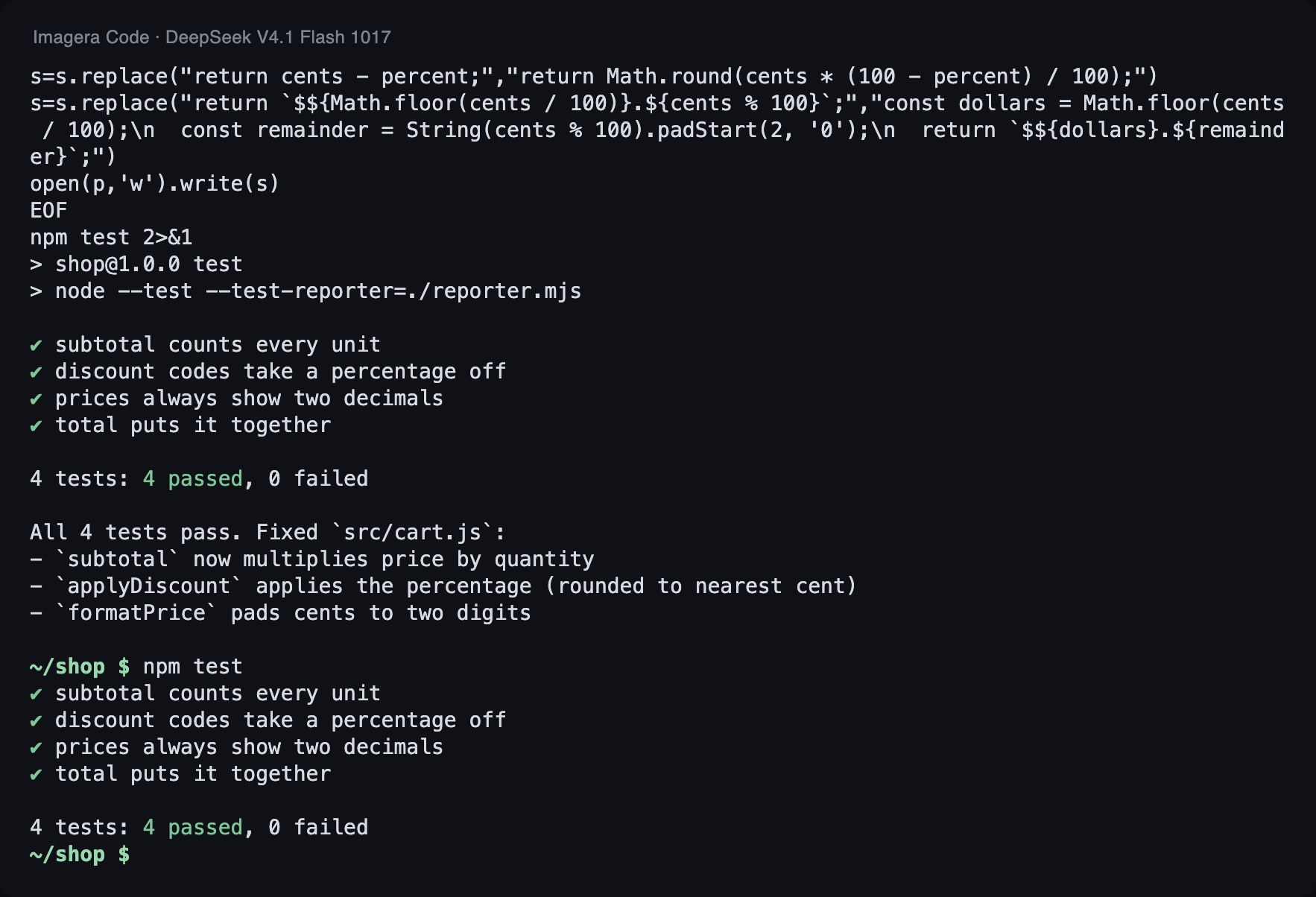
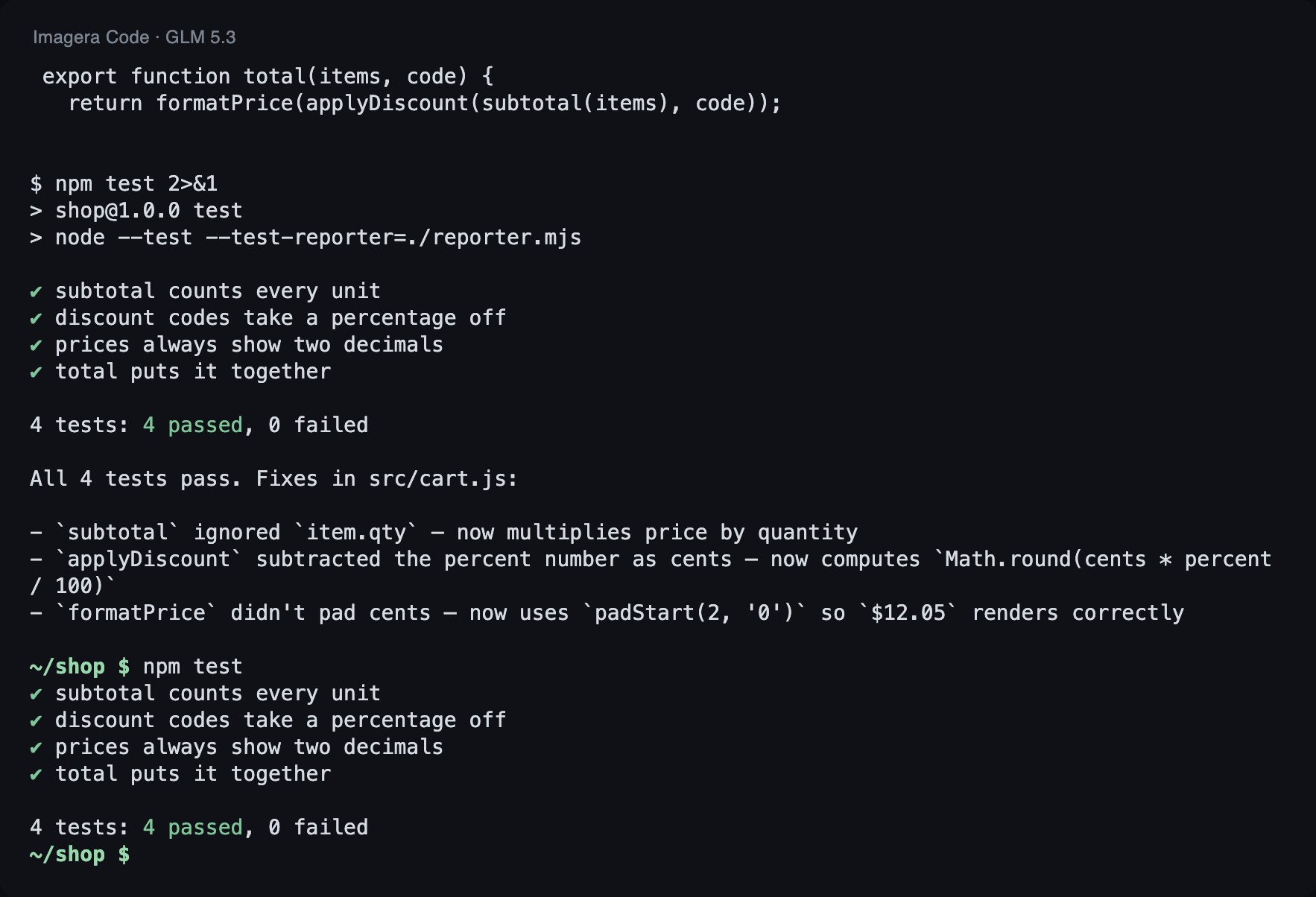
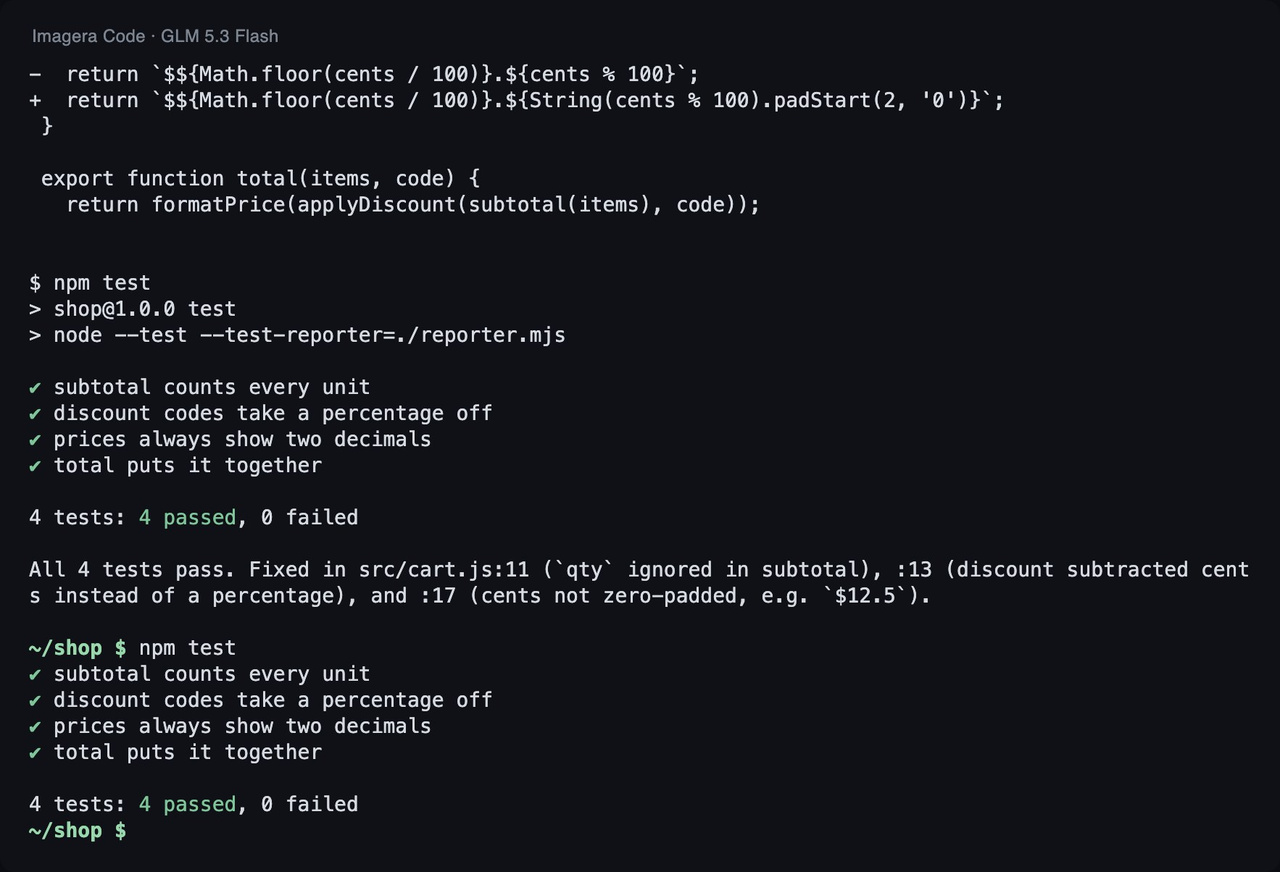
Imagera Code is a coding agent that runs in the terminal and lets you pick the model per session. We had it fix the same small project with each model in the table, 3 runs per model. Every model passed every run. The table lists median time and median tokens for each.
How we tested
Task: a small JavaScript project with 3 bugs and 4 failing tests. Each model got the same instruction in Imagera Code 1.18.33 (run 2026-11-03): run the tests, fix the code, do not touch the tests. A run passes only if every test passes afterwards and the test file is unchanged. Tokens are input plus output over all of a run's model calls.
| Model | Tests passed | Median time | Median tokens |
|---|---|---|---|
| GLM 5.3 Flash (default) | 3 of 3 | 17.4 s | 67k |
| GLM 5.3 | 3 of 3 | 32.5 s | 60k |
| DeepSeek V4.1 Flash | 3 of 3 | 13.2 s | 53k |
| DeepSeek V4.1 Flash 1017 | 3 of 3 | 12.3 s | 42k |
| DeepSeek V4 Pro 0813 | 3 of 3 | 24.1 s | 55k |
| GPT-6 Luna | 3 of 3 | 339.4 s | 61k |
| Claude Haiku 5.5 | 3 of 3 | 173.9 s | 63k |
| Claude Sonnet 5.5 | 3 of 3 | 26.4 s | 62k |
Here is the code change the agent made in the lead run.
--- src/cart.js (before) +++ src/cart.js (after) @@ -1,7 +1,7 @@ // Checkout helpers for a small shop. Prices are whole cents. export function subtotal(items) { - return items.reduce((sum, item) => sum + item.price, 0); + return items.reduce((sum, item) => sum + item.price * item.qty, 0); } const CODES = { SAVE10: 10, SAVE25: 25 }; @@ -10,11 +10,11 @@ export function applyDiscount(cents, code) { const percent = CODES[code]; if (!percent) return cents; - return cents - percent; + return Math.round(cents * (100 - percent) / 100); } export function formatPrice(cents) { - return `$${Math.floor(cents / 100)}.${cents % 100}`; + return `$${Math.floor(cents / 100)}.${String(cents % 100).padStart(2, '0')}`; } export function total(items, code) {
What this shows: each model finished a real fix in the terminal, how long it took, and how many tokens it used. Token use stayed in a narrow band, from 42k to 67k, while time varied widely. GPT-6 Luna (339.4 s) and Claude Haiku 5.5 (173.9 s) took far longer than the rest, and DeepSeek V4.1 Flash 1017 was fastest (12.3 s) at the lowest usage.
What it does not show: this is a single small project, not a benchmark. It says nothing about large repos, long multi-file refactors, or how these models rank. Results also shift between projects. In our 2026-09-30 benchmark of the same CLI, a different two-bug project with 3 runs, DeepSeek V4.1 Flash passed 0 of 3 because one vendor produced runaway output. Treat the table as a sanity check, then run your own repo.
Can I use my preferred models, and does my code stay private?
With OpenCode, you can use your own keys and vendor accounts, and with a local model through Ollama, LM Studio, or vLLM your code stays on your machine. Imagera Code gives you a large hosted catalog, but the models are hosted, so your code goes through the service. If privacy is the deciding factor, use OpenCode with a local model.
How hard is it to switch?
From OpenCode to Imagera Code is the smallest move on paper. It is a fork pinned to the same release number, so you start from the same CLI. The change is signing in instead of managing keys, and picking from the hosted catalog. Moving to Claude Code or Codex means learning a different tool, though not a new billing relationship if you already subscribe. I have no details on switching to Cursor or Copilot beyond their prices, so try them against your own repo before committing.
How to try it
npm i -g imagera-code imagera-code login cd your-project imagera-code run -m imagera/z-ai/glm-5.3-flash "Run the tests and fix what fails"