The brief said thirty seconds. The model gave you eight.
So you generated nine more clips and cut them together, and now the jacket changes shade at 0:11, the face softens at 0:19, and the street behind your subject has different cars every time you cut back. That is not a render bug. It is the hardest unsolved problem in video generation, and every vendor's duration parameter is a quiet confession about it.
An eight-second clip is a GIF with ambition. Thirty seconds is a scene — a pre-roll ad, a product story beat, a hook-body-payoff you can put on an invoice. That gap is the gap between a demo and a deliverable, which is why the duration ceiling is the spec that decides what you can sell.
Status, as of 2026-07-29: every number below was read from first-party vendor docs on that date. Where a vendor's docs would not serve, the row says "not verifiable" rather than guessing.
Why does my AI clip fall apart after eight seconds?
Because generation cost rises quadratically with clip length and every new frame is conditioned on an already-imperfect previous frame. The literature names the two failure modes precisely: error accumulation and attribute drift. Eight seconds is roughly where drift becomes visible to a viewer who is not looking for it.
Nothing "breaks" at second nine. There is no cliff in the architecture; tiny per-frame inaccuracies compound — frame 200 inherits the drift of frame 199. A 2026 survey of long-video generation puts it in one line: generating long videos "remains challenging due to error accumulation, attribute drift, and the limited availability of long video data" (arXiv 2606.22370).
The second half matters most. Training corpora are built from short clips, so a model that has mostly seen five-second segments has no strong prior for what a thirty-second take looks like — how a face settles, how a shadow travels across a long hold.
What is the real duration ceiling on every shipping model?
Native single-pass ceilings currently run from fixed 5 seconds on older open-weight models to 20 seconds on Sora 2. The Wan API line tops out at 2–15 seconds. Anything longer than that ceiling is extension or stitching, not one continuous generation.
One pass versus chained passes, from vendor documentation read on 2026-07-29.
| Model | Native (single pass) | Extension mechanic | Documented total |
|---|---|---|---|
| Veo 3.1 / 3.1 Fast | 4, 6 or 8 s | +7 s per pass, up to 20 passes | up to 148 s combined |
| Sora 2 / Sora 2 Pro | 16 s or 20 s | up to +20 s, up to 6 passes | 120 s max |
| Wan 2.7 t2v (API) | 2–15 s, default 5 | i2v exposes video continuation | not documented |
| Wan 2.7 i2v (API) | 2–15 s | first-frame, first-and-last-frame, continuation | not documented |
| Wan 2.7 videoedit (API) | 2–10 s | — | — |
| Wan 2.6 t2v (API) | 2–15 s, default 5 | — | not documented |
| Wan 2.5 t2v preview (API) | 5 s or 10 s only | — | not documented |
| Wan 2.2 / 2.1 plus & turbo (API) | fixed 5 s, cannot be changed | — | — |
| MiniMax Hailuo 2.3 / 02 | default 6 s; to 10 s at 768P, 6 s at 1080P | — | not documented |
| Luma ray-2 / ray-flash-2 | not documented | extend supported | not documented |
| Wan 2.2 T2V-A14B (open weights) | 5 s at 480P and 720P | — | — |
| HunyuanVideo (open weights) | default 129 frames, listed as 5 s | — | — |
| LTX-2 / LTX-2.3 (open weights) | no maximum stated | — | — |
| Kling / Seedance / Runway | not verifiable from first-party docs on 2026-07-29 | — | — |
Four rows are worth stopping on.
Veo's 8-second cap is conditional, and the condition is strict. Google's Gemini API docs allow 4, 6 or 8 seconds, but the value "must be 8 when using extension, reference images or with 1080p and 4k resolutions" (Gemini API — Veo). The moment you want a reference image for character consistency, your shot length is decided for you.
Sora 2 leads on native length among models with public specs. OpenAI documents that both sora-2 and sora-2-pro "support 16- and 20-second generations" (OpenAI video generation guide). Twenty seconds in one pass is two-thirds of a thirty-second spot from a single generation.
The Wan API ceiling has tripled across three releases. On Alibaba Cloud Model Studio, wan2.1-t2v-plus and wan2.2-t2v-plus are "Fixed at 5 seconds and cannot be changed", wan2.5-t2v-preview allows only 5 or 10, and both wan2.6-t2v and wan2.7-t2v take "An integer from 2 to 15" (text-to-video API reference).
Open-weight models are quiet about it. The Lightricks LTX-2.3 card states no maximum duration at all — its only length constraint is that "Frame count must be divisible by 8 + 1." An absent ceiling is not an infinite one; the practical limit is your VRAM and your tolerance for drift.
If your clip is breaking today, you don't have to wait for a higher ceiling
Nobody ships a 30-second scene as one generation right now. What working studios ship is six five-second shots, sequenced deliberately, with identity and lighting locked across them — which is a planning problem, not a model problem.
That is exactly what the cinematic video studio is built for: generate a shot, keep what works, iterate the one take that failed. Credits mean a failed take costs a retry, not a per-second penalty on the whole clip.
Why is length so expensive to generate?
Three compounding costs: self-attention scales quadratically with sequence length, temporal compression past 4× degrades reconstruction, and each frame inherits the previous frame's error. Doubling a clip does not double the cost. It multiplies it, and it multiplies the drift alongside it.
The attention bill
Video diffusion transformers attend across the whole token sequence — frames × height × width. Long-context research is direct about the wall: "scaling diffusion transformers to generate long-context videos is fundamentally limited by the quadratic cost of self-attention" (arXiv 2508.21058). Five seconds to thirty is a 6× token increase and roughly a 36× attention cost before any optimisation.
The compression bill
The industry answer is to squash video into a smaller latent space with a temporal VAE. Wan 2.2 ships "a high-compression Wan2.2-VAE, which achieves a T×H×W compression ratio of 4×16×16, increasing the overall compression rate to 64" (Wan2.2 repository). That is what makes its TI2V-5B model runnable on consumer hardware — the repo notes it "can generate a 5-second 720P video in under 9 minutes on a single consumer-grade GPU".
But compression is not a machine that prints length. Tokeniser research finds that "extending state-of-the-art video tokenizers to achieve a temporal compression ratio beyond 4x without increasing channel capacity poses significant challenges", and that a low-compression encoder on subsampled video beats a high-compression encoder on the original (arXiv 2501.05442). Squeeze time harder and you buy length with fidelity — the mush you see in long generations.
The memory bill
The same research frames long video as "fundamentally a long context memory problem: models must retain and retrieve salient events across a long range without collapsing or drifting." The model has to remember at second 27 what the jacket looked like at second 2. Nothing in a standard diffusion pass guarantees that.
What breaks first when a clip runs long?
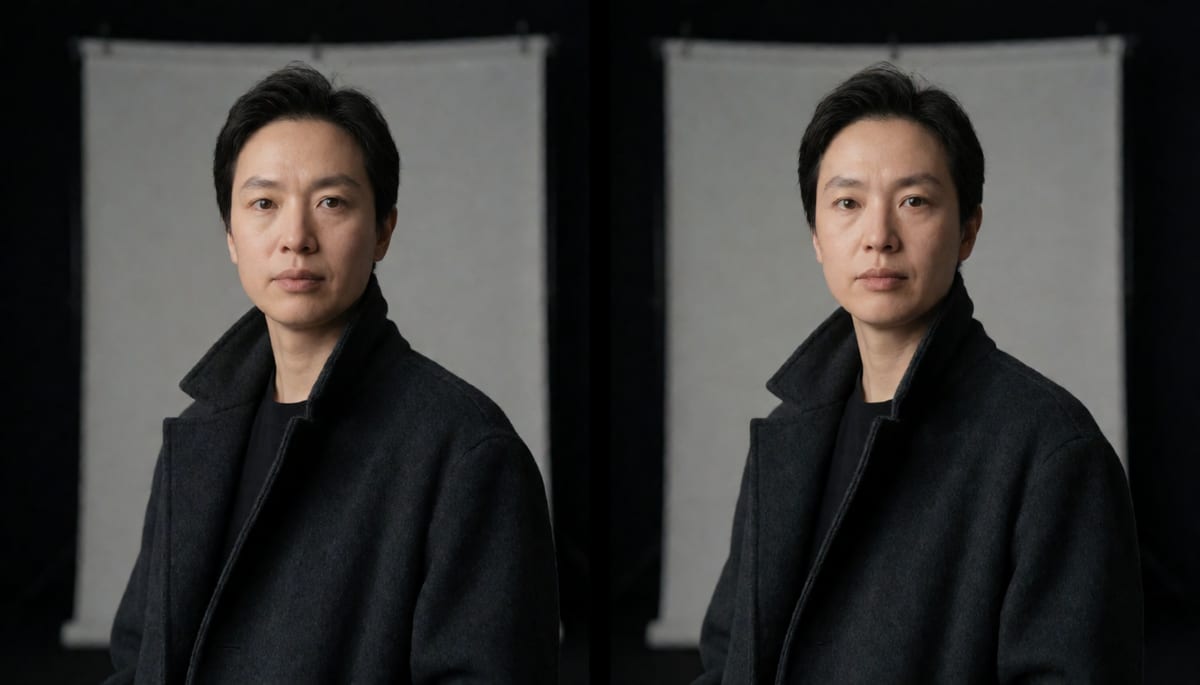
In practice, in this order: face, then wardrobe detail, then lighting direction, then background population. Identity goes first because faces carry the most information in the fewest pixels, so small latent errors read as a different person almost immediately.
Use that order as a QC checklist rather than watching for a vague sense of wrongness:
- Face. Screenshot the last second, compare to the first. If jawline, hairline or eye spacing moved, the take is dead however good the motion is.
- Wardrobe detail. Buttons, logos, collar shape, jewellery. Broad colour survives longest; hard-edged detail dies first.
- Lighting direction. Find the key light in the first and last frame. A shadow migrating across the face mid-take is the tell that reads as "AI" to a client who cannot explain why.
- Background continuity. Signage, parked cars, extras, shelves — re-invented constantly, and nobody notices until it is on a big screen.
- Motion physics. Cloth, hair and liquid drift last but worst: physical to floaty.
Is one native 30-second take better than six stitched clips?
Yes for anything with a continuous camera move or a sustained performance, and it is not close. Stitching is fine when you can cut. The seam is invisible only when it lands on a cut the viewer expects — motion, an audio beat, a change of angle.
What viewers register at a seam, loudest first: a lighting jump (the eye is calibrated for continuity of light), a pose discontinuity (the hand was rising, now it is lowered — a glitch, not a cut), a background swap, and a grain change from a different resolution tier.
The vendors themselves document what extension costs you:
| Vendor | Extension rule | The penalty you actually pay |
|---|---|---|
| Veo 3.1 | +7 s per pass, ≤20 passes, ≤148 s combined | base clip forced to 8 s; "720p only for extension", so 1080p and 4k cannot be extended |
| Sora 2 | ≤+20 s per pass, ≤6 passes, 120 s max | 1080p exports require sora-2-pro; the older remix endpoint is being deprecated in favour of edits |
| Luma | extend supported | "Extend is currently supported only for generated videos" — not footage you brought in |
| Wan 2.7 | i2v supports first-frame, first-and-last-frame and video continuation | videoedit tops out at 10 s versus 15 s for t2v and i2v |
Read the Veo row twice. Extension is not additive on top of your best output — it forces you to 720p and locks the base shot at 8 seconds. A documented resolution downgrade in exchange for length.
The genuinely useful primitive in that list is Wan 2.7's first-and-last-frame-to-video mode (image-to-video API reference). If you can specify both ends of a shot, you can make the last frame of shot 3 the first frame of shot 4, and the seam disappears because it is the same image.
How do I build a 30-second sequence that holds continuity?
Lock one canonical keyframe of your subject first, then generate every shot from that same still rather than from text. Six shots, five seconds each, cut on motion. Identity survives because it is never re-invented — it is re-used.
Step 0 — build the anchor. One still of your subject: correct lighting, correct wardrobe, neutral pose, at delivery resolution. Your continuity bible. Every shot starts here. Ten minutes on it saves two hours of retakes.
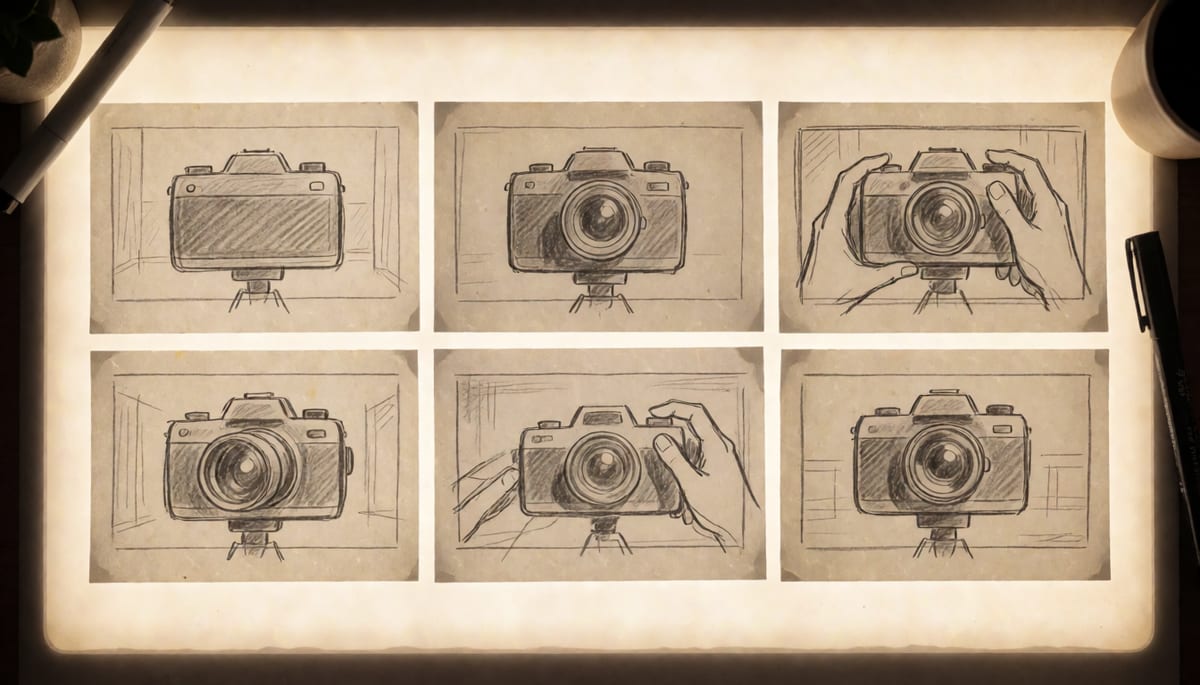
Step 1 — write the shot list before generating anything.
| # | Time | Shot | Job | Continuity anchor |
|---|---|---|---|---|
| 1 | 0:00–0:05 | Wide establishing, slow push in | Hook, set place and tone | Anchor still as first frame |
| 2 | 0:05–0:10 | Medium, subject begins the action | Set up the problem | Anchor still, wardrobe line verbatim |
| 3 | 0:10–0:14 | Insert — hands, product, texture | Detail and credibility | No face in frame; drift cannot hurt you |
| 4 | 0:14–0:20 | Reverse angle, reaction | The turn | Anchor still, mirrored framing |
| 5 | 0:20–0:26 | Motion beat, lateral camera move | Energy lift | Last frame of shot 4 as first frame |
| 6 | 0:26–0:30 | Resolve, hold, end card | Payoff and CTA | Anchor still, wide again |
Step 2 — write one wardrobe-and-light block and paste it into all six prompts, unedited. Identical strings, not paraphrases: "Charcoal wool coat, three buttons, silver ring on right hand, key light camera-left at 45 degrees, overcast daylight." Every re-description is a re-roll of the model's interpretation.
Step 3 — put the shot without a face in the middle. Shot 3 exists to absorb drift. Cut to hands or product at the point where a single long take would already be failing, and you have bought a clean identity reset for shot 4.
Step 4 — cut on motion. Never cut on a static hold. If shot 2 ends mid-turn and shot 3 starts mid-gesture, the eye is tracking movement and cannot audit continuity. Oldest trick in editing; beats every technical fix.
Step 5 — grade as one piece. A single colour pass across all six shots erases most residual lighting drift.
What can I start in the next ten minutes?
Shot 1. Just shot 1. Generate the anchor still, then one five-second wide establishing shot from it. That single clip tells you whether your subject, lighting and prompt block hold — before you have spent anything on the other five.
That is the point of sequencing: the unit of risk is five seconds, not thirty. If shot 4 fails you re-run shot 4 — not the whole spot.
Open Imagera's cinematic video studio and do shot 1 now. If your source is a photo of a person, the human reel maker runs the anchor-still workflow and handles framing for you. Selling an object, the product reel maker is built around exactly the insert shot in row 3. And if you already have long footage that needs to become cuts rather than the reverse, video to reels is this workflow run backwards.
Is Wan 3.0 real, and does it change any of this?
No Wan 3.0 exists publicly as of 2026-07-29. There is no wan3 model on Alibaba Cloud Model Studio, no Wan3 repo on the Wan-Video GitHub org, and no Wan3 model under the Wan-AI Hugging Face org. Anything carrying a Wan 3.0 spec sheet is a claim, not a specification.
The confirmed-versus-claimed split:
| Claim | Status on 2026-07-29 | Evidence |
|---|---|---|
| A Wan 3.0 model is publicly available | Not confirmed | No wan3 id on Model Studio's model list; newest is wan2.7-image-pro |
| Wan 3.0 weights are on Hugging Face | Not confirmed | The Wan-AI org lists 24 models; newest numbered line is Wan2.2 |
| A Wan 3.0 repo exists on GitHub | Not confirmed | The Wan-Video org shows "5 of 5 repositories", topping out at Wan2.2 |
| Wan 2.7 exists as an API model | Confirmed | wan2.7-t2v documented at 2–15 s, 720P and 1080P |
| Wan 2.7 is served by third-party clouds | Confirmed | Together AI serves Wan-AI/wan2.7-t2v at a listed rate of $0.10 per second of generated video |
| Open weights and the API line have diverged | Confirmed; unexplained | Open weights top out at Wan2.2 (Apache 2.0); wan2.5/2.6/2.7 exist as API ids only. No vendor page states why |
| The lab is working on minute-scale coherence | Confirmed direction | Wan-Dancer, introduced 13 July 2026, is "A Hierarchical Framework for Minute-scale Coherent Music-to-Dance Generation" |
That last row is the real signal. Wan-Dancer is an Apache-2.0 release whose stated purpose is minute-scale coherence — not five seconds, not fifteen. When a lab ships a framework for holding a subject together across a minute, the ceiling in the next numbered release is the thing to watch. Two smaller tells: the Wan2.2 repo's Latest News has not moved since 13 November 2025, and Google's Gemini API video overview now tells developers to "Use Gemini Omni Flash as your default model for video generation" rather than naming Veo.
New video engines land in Imagera as they become available, and early access goes out through the studio. There is no date to promise and no form to fill in. What actually decides whether a longer ceiling is useful to you is whether your shot list, reference frames and house look already exist — so build them on what ships today and treat the ceiling lift as an upgrade, not a rescue.
What does thirty seconds actually unlock?
A billable unit. Eight seconds sells as a social loop; thirty seconds is the standard length of a pre-roll ad, a product launch film and a broadcast spot. It is the shortest format a client pays agency rates for, which is why the ceiling matters commercially and not just technically.
Run the arithmetic on your week. Six shots per cut, two or three takes each: fifteen to twenty clips per deliverable. Long native takes are billed by the second — Together AI's listed rate for Wan 2.7 is per second of output — so every failed fifteen-second take is the most expensive object in your pipeline. Sequenced five-second shots fail cheaply. Until the ceiling moves, short units keep your cost of failure low.
Imagera is priced in credits rather than per second of output, which is what makes sequenced shots affordable to iterate:
| Plan | Credits | Price |
|---|---|---|
| Pro (best value) | 500 | $19.99 |
| Business | 1,500 | $49.99 |
| Ultra (lowest cost per credit) | 6,500 | $199.99 |
All plans show at roughly half price right now. Monthly plan credits reset with each cycle; add-on credit packs never expire, so capacity you top up for a launch is still there next quarter.
Every week spent waiting for a longer native ceiling is a week a competitor shipped a thirty-second spot with the tools that exist. Sequencing is not a compromise you tolerate until the next model lands — it is how you would cut the spot anyway. When the ceiling moves, you will have fewer seams.
Start with the anchor still and one five-second shot in the video studio. Compare what this generation of models holds on the model comparison surface. And if you want the sequencing handled for you from a single photo, the universal reel maker runs the same shot logic end to end.